
Glazing units and glass
A glazing unit is a sealed assembly of two or more panes, held apart by aluminium spacers that form one or two air chambers. For better insulation the chambers can be filled with argon.
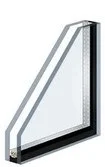
Windows are the weakest point of a home: they lose the most heat. The glazing usually makes up 75% to 90% of a window’s area, so it plays a big part in the heat and sound insulation of your home.
The main property is the number of panes: two (one chamber) or three (two chambers, the so-called triple glazing). Panes can be combined; the most important are those that insulate against heat and bring your windows up to the European energy-efficiency standards.
Types of glazing unit
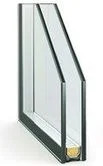
Double glazing (one chamber)
Two panes held apart by a spacer, forming one sealed insulating air chamber. Double glazing is usually 20 to 32 mm wide, though other widths are made to suit the profile. The panes start at 4 mm thick. The most common are 20 mm for aluminium structures and 24 mm for 3- and 4-chamber PVC profiles.
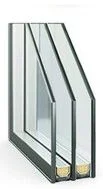
Triple glazing (two chambers)
Three panes held apart by two spacers, forming two sealed insulating air chambers. Triple glazing usually runs from 32 mm to over 50 mm. It insulates better against noise, especially when the panes differ in thickness, which absorbs resonant vibration better. Triple glazing is an expensive investment, and at least one pane should be heat-insulating.
We recommend double glazing with one low-e pane over triple glazing with three ordinary panes.
Types of glass
Glass comes with many different properties for different needs. The usual choice is ordinary clear float glass, 4 mm thick.
Heat-insulating glass
The most common special glass insulates against heat: low-emission glass, known as low-e or “K-glass”, and high-performance glass known as Sunergy, “four seasons”, “all-season” or thermal glass. We explain the difference in Low-e or Sunergy glass.
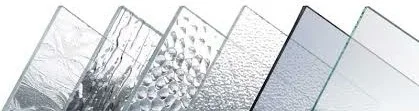
Patterned glass
Used mostly for doors and partitions. It lets light through but stops a clear view; how much it obscures depends on the pattern. It can go into a glazing unit or be fitted as a single pane.
Safety glass
Laminated glass (“triplex”) is two or more panes bonded with a thin clear film of resin or foil. When struck, the glass breaks but the pieces stay stuck and do not scatter. It is used for shop windows, railings, low structures and other places with a high risk of breakage, most often in public buildings, on its own or in a glazing unit. Safety glass also includes toughened glass, which is stronger and breaks into small blunt pieces, and wired glass with a metal mesh inside, which resists fire and impact; when it breaks, the mesh holds the pieces.
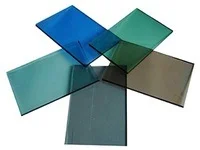
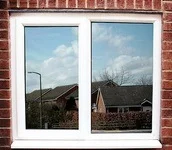
Tinted and mirror glass
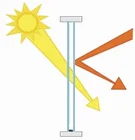
These are decorative and let less light through, but they reflect part of the sun’s energy and help in summer. Tinted glass is most often green, blue or brown. Mirror glass gives a mirror effect that is not seen from the inside.

Data of popular glazing units
| Glazing unit | Width | Heat transmittance | Light transmittance | UV transmittance | Sound insulation |
|---|---|---|---|---|---|
| white/white | 24 mm | 2.7 W/m²K | 81% | 44% | 29 dB |
| white/low-e | 24 mm | 1.3 W/m²K | 80% | 42% | 30 dB |
| Sunergy/white | 24 mm | 1.3 W/m²K | 78% | 28% | 30 dB |
| Sunergy/white | 24 mm + argon | 1.2 W/m²K | 78% | 28% | 32 dB |
| white/white | 32 mm | 2.1 W/m²K | 81% | 44% | 30 dB |
| Sunergy/white | 32 mm | 1.2 W/m²K | 69% | 28% | 30 dB |
| Sunergy/white | 32 mm + argon | 1.1 W/m²K | 80% | 27% | 32 dB |
| white/white/white | 32 mm | 1.9 W/m²K | 74% | 44% | 33 dB |
| Sunergy/white/white | 32 mm | 1.2 W/m²K | 69% | 27% | 33 dB |
| Sunergy/white/white | 32 mm + argon | 1.0 W/m²K | 69% | 26% | 35 dB |
| Sunergy/white/low-e | 32 mm | 0.8 W/m²K | 63% | 21% | 33 dB |
More products
A free visit and measurement
Call our representative in Shumen or in Varna. We visit you free of charge, look at the openings and take exact measurements.